

Our Historic Buildings Part 1: Washington's Old Town Hall
In 1986, The Old Town Hall, the Red School House and St. Andrews Chapel were officially listed on The National Register of Historic Places, along with a number of houses in town. Some, alas, have since been torn down; Carol Lew wrote movingly about the demise of the Messenger house in the January issue of Tracks. We continue this series with the Town Hall in all its permutations.
The old records tell us that, in 1766, a tax was levied by the early settlers of Western Massachusetts to “keep the county road through Heartwood clear and in good repair.” If you were traveling from Springfield or Boston to Pittsfield or the Port of Albany in the later 1700’s or early 1800’s, before a road was built down in the valley and before the train, you would have been rocking along in a stagecoach pulled up “the high hills of Washington Center” by a team of horses. And if it was after 1771 or so you probably would have stopped up on the plateau at the Tavern where the Lew house now stands. You might have gotten a meal, a rest and a new team of horses before plunging down the hill into Pittsfield.
It was along this road—sometimes called Center Street, or County Road—where most of our historic buildings still stand. Without the diligence, thoughtfulness and persistent hard work of our town residents over the years we would not have these cherished buildings. The stories of their precarious histories and preservation are inspiring—and perhaps timely.
The original Town Hall, also called the Meeting House and often, as was common at that time, functioning as a church, was located on the hilltop—on the spot where our current Old Town Hall now stands. In 1767, “boards and shingles” were purchased “to cover the meeting house,” according to the original “Proprietors Book.” In 1768 an acre of land was cleared and the building was framed, presumably ready for the procured wood. Sally Poland, a former Washington resident, compiled another history and reported that the Meeting House stood for 20 years until it “was injured by lightening” and another house was erected in 1792 across the road on the town green, now approximately marked by granite posts.
In winter, it was often to the warmth of the nearby Tavern that the chilled attendants of church services or town meetings ended up before returning home. In records of early town meetings, sessions were often adjourned to the Tavern once the meeting was called!
By 1848, town residents must have felt the need for a designated Town Hall as they voted “to locate the Town House south of the burying ground gate” and by 1850 the annual town meeting was held at the “Town Hall” – our Greek Revival style building now listed on the Historic Register.
There is not a lot of early information about the Town Hall in the history book for our town, published for the Washington Bicentennial in 1977. After 1900, the book chronicles reunions and colorful celebrations in and around the hall.
In 1936, a group of current and former residents, called Washington Sons and Daughters, held their 28th reunion on the hilltop. “A thrilling feature of the day,” according to the town history book, “was its auspicious opening, under fair skies, with a covered wagon parade which started at the Myron Messenger farm and proceeded to the Town Green under escort of armed guards…. a campfire was made and the passengers in the wagons who’d been singing all the way, alighted and formed a circle with the guests who all joined in the singing….”
What a day it must have been. But more serious drama was to unfold on the hilltop when World War II began and everyone in the country felt vulnerable. The possibility that the United States would be bombed, or invaded, felt real. Even in Washington, a Civil Defense Corp was organized, air raid wardens were appointed, ration books for food and gasoline were issued….The flashing beacons on the hilltops were darkened, air raid warnings were sounded for practice alerts…wardens walked the town roads to see that windows were completely dark…
The Old Town Hall became Washington’s Civil Defense Headquarters, and a Watch Tower was installed on top with windows on four sides. Its 2000-foot altitude made it ideal for plane spotting! Wardens were assigned shifts. It was a good-natured joke, according to the town history, that “Emil Schulze and Walter Beckwith were paired as watchmen—Emil had poor eyesight and Walter was hard of hearing but together they could do it alright.” Fortunately, “the only war planes spotted were our own…”
By 1965, the situation for the Town Hall had turned precarious. The building had become dilapidated. Town meetings had moved down to the School on Summit Hill Road where plumbing and electricity were available and there was no need to fill up a wood stove for heat. It’s been told that in the early days, before the move down to the school, Fred Simmons would don his snowshoes in the early morning on election day and tromp up the hill from his house; he would get the fire going in the stove to warm the old building for voters.
Two articles in the warrant for the 1965 annual town meeting made a contentious evening inevitable; would the townsfolk vote to raise money for renovation of the Old Town Hall, or would they vote for its demolition? According to the town history some argued: “Bulldoze it down and burn it…”
In the end booth articles were defeated. The building was left in limbo. But longtime tax collector and member of the Sons and Daughters, Marguerite Schulze, started what would be a successful publicity campaign to save the building, imploring fellow citizens “to preserve this landmark as evidence of our history and as a heritage for generations to come.”
Residents stepped up, literally onto the leaky roof and into the moldy interior and set to work. Contributions came in; the civil defense tower was removed. Shingles and roofing were donated by Kelly Hardwood in Pittsfield.
A photograph in the October 20, 1965, issue of the Berkshire Eagle shows several town residents on the peak of the hall. Ladders lean on the northern side of the building. According to the article, half the roof was completed by the end of the day and residents, working weekends, would finish the job. Windows would be boarded for winter and repaired in the spring when the clapboards would get a fresh coat of paint.
In the fall of 1968, the Sons and Daughters had their annual Town Meeting and Open House to celebrate the renovation of the Town’s beloved building.
And here we are, nearly 57 years later, and the building shines on our mountaintop. Resident Mark Roos of Pinnacle Painting Company spent several weeks last summer giving the clapboards and trim another fresh coat of paint. Upkeep continues.
But there are problems, according to Tom Hoffman, head of the Washington Historic Commission. The foundation needs repair: the stonework is crumbling, and the roof needs replacing as well. Funds need to be raised. Grants written. Now in precious condition, the building needs to be cared for once again.
At the February 24th Select Board meeting, several residents, including Tom Hoffman and Ellen Bond of the Sons and Daughters, asked if there was a way for the Old Town Hall to be used, as it is annually by the Sons and Daughters, for a fund raising event, an art exhibit, or even a square dance. The board is considering the possibility. It was noted that applications are available for rental of St. Andrews Chapel; perhaps the Town Hall could follow suit.
This 1964 photo shows the watchtower that was added to the roof of the Old Town Hall during World War II for plane spotting. In 1965, renovation would begin and the tower would be removed.

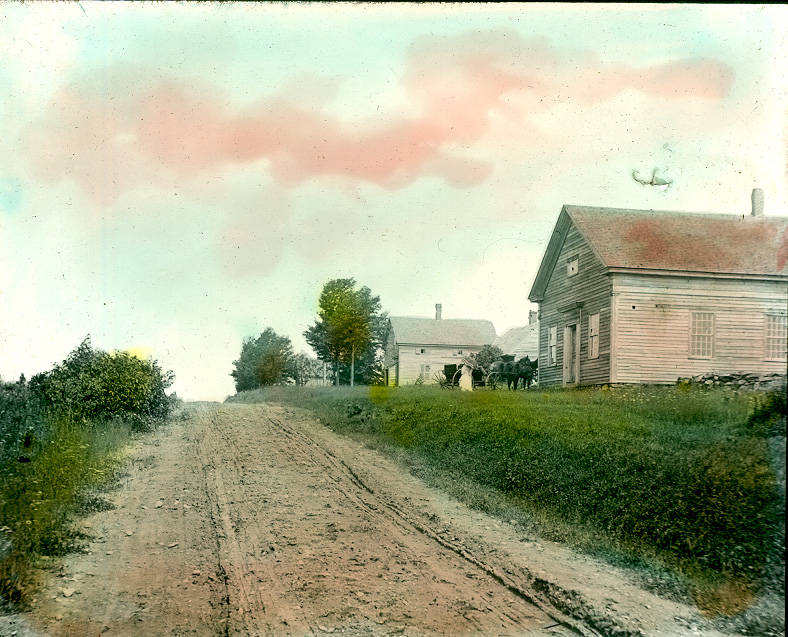
Our Old Town Hall in a colorized lantern slide from the 1890s, which gives a sense of what it might have felt like coming up the dirt road into the high hill of Washington Center.