

The Precarious History of St. Andrew’s Chapel
As the 250th Anniversary of our town approaches we look again to our history and the buildings that remind us of our heritage: The Old Town Hall, the South-Central School House and St. Andrew’s Chapel, all now listed on The National Register of Historic Places. Each one has been preserved for us by the diligence of town residents past.
Tracks articles in May and July of this year have covered the history of the Old Town Hall and the Red School house. But what of St. Andrew’s Chapel?
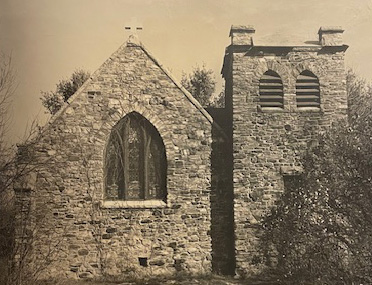
How many residents know that the fortress-like, early Gothic style Chapel was nearly torn down about 50 years ago, around the time of our Bicentennial celebration? Then a battle was brewing between the Town of Washington and Bishop Alexander D. Stewart, head of the Episcopal Diocese of Western Massachusetts in Springfield, overseer of Saint Andrew’s Chapel on Washington Mountain Road.
By then the chapel was over 75 years old. Interestingly, it had been built, in 1899, on the very spot where William Gay Ballantine, the first minister in our town (serving from 1774 to 1820) made his home. Ballantine’s farm would become Bucksteep Manor, the home of George F. Crane of New York City. In the 1890’s Crane and his wife visited Scotland and were impressed by the manor houses they visited, notably an estate called “Bucksteep Manor.” Once home they wanted to duplicate the place of their dreams and found the perfect spot—the former Ballantine property in Washington. After a year, the Cranes felt their Manor was not complete without a chapel. St. Andrew’s was soon built as a memorial to Mrs. Crane’s parents, the Reverend Andrew Oliver D.D. and Adelaide Imlay, his wife. According to our town history book, services were held when the family was in residence during the summer months and in December when they held Christmas parties for neighboring children, “giving them oranges and small gifts.” At the time, sheds for horses and their carriages or sleighs stood across the road from the gateway to Bucksteep.
Described as an “Early Gothic Structure,” the field stone chapel was completed in 1900 after the plans of George C. Harding of Pittsfield. In its early years the chapel fulfilled the family’s desire for a place of worship but, as their children grew up and their home was little used, Crane deeded the property, in 1927, to what became the Episcopal Diocese of Western Massachusetts.
Crane could never have anticipated the difficulties this gesture would present to the diocese and to the town.
Initially, when the diocese took ownership of Bucksteep Manor and St. Andrew’s Chapel, it was used as a conference and training center and later a summer camp for the Girl’s Friendly Society. But as time went on the manor and chapel fell into disuse.
When Rudolph Sacco purchased Bucksteep Manor and the surrounding land in 1971, the chapel, and its approximately 1/4 acre was retained by the Diocese.
By 1976, because it was so little used, Bishop Stewart decided to sell the chapel to a young couple from Becket interested in making it their home. This effort was blocked by the Town of Washington’s bylaws as the quarter-acre lot did not conform to the two-acre zoning required at that time. “It’s a lonely church on a lonely road and it deserves its eternal rest,” the bishop stated. He hired Associated Building Wreckers of Springfield “not to demolish,” he was careful to add, but to “dismantle the church.” The cross and windows, for example, were to go to a church in Dalton. Stewart claimed that the chapel had little significance for the town. He called it merely “a summer chapel for wealthy tourists until 1940” and noted that, in an effort to revive its use, the Diocese had opened the chapel doors in 1960 for Sunday services but only five or six people attended, and three of them were from out of town. The chapel closed in 1961. Stewart claimed its demolition had been contemplated for 10 to 15 years. “It’s done its job, why not let it go to rest?” he argued.
Sally Poland, head of the Historic Commission, had been writing to the diocese for six years asking for the Chapel to be turned over to the town, which had raised $3000 for its preservation.
But Stewart was prejudiced against this, worried that the church would become “a source of embarrassment to the diocese.” New owners, he felt, might turn it into a tavern or “a bootleg church with a mail-order minister” and “some oddball happenings.”
The select board was miffed. They’d sent their Harvard-educated member— Henry Maclaren— to discuss the matter with Bishop Stewart and representatives of the diocese in Springfield. The bishop didn’t budge. Select Board Chair, Daniel O. Phillips, was impatient with the bishop’s “stubborn opinions” and stated at the Board’s July 21 meeting that it was time to “let everyone know what was happening to the chapel through newspapers, television and radio. We need to talk to the bishop man-to-man.”
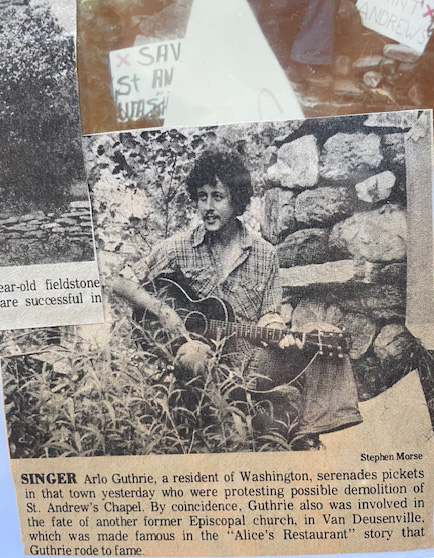
It was summer. Protests started. The town was in an uproar. News articles appeared in the Berkshire Eagle, The Dalton News-Record and even the Sunday edition of the Boston Globe (August 14, 1977). It was estimated that half the town was out picketing. Older folks brought lawn chairs and were ready to place themselves between the bulldozer and the chapel. Arlo Guthrie arrived and serenaded the protesters. According to a news article, Rose Borgnis’s father was in charge of the town dump when he got a call from the demolition company saying they’d like to get a permit to dispose of debris from the church. He said to Rose, “If you want to get married in that church, you better get busy.” She was 13. She called her grandmother and more phones started ringing. Sally Poland wrote another letter assuring the bishop that the town would take good care of the church, and respect its religious history, the same respect shown to the recently refurbished Old Town Hall and the Red School House.
Worn down by the protesters and news articles and pleas from the town, Bishop Stewart decided it wasn’t his decision to make. He agreed to put the matter before the diocesan Board’s September meeting, even though the council had already voted to dismantle the church.
The Select Board and Judge Sacco, the town counsel, composed a letter to the Diocesan Council and, surprisingly, the Council made the right choice. They voted to save the Chapel and to deed it to the town for $l.
Once again, residents stepped up, this time to care for the Church, just as they had for the town hall and the school. Materials were donated and construction crews hired to mend the roof and re-point the stone work.
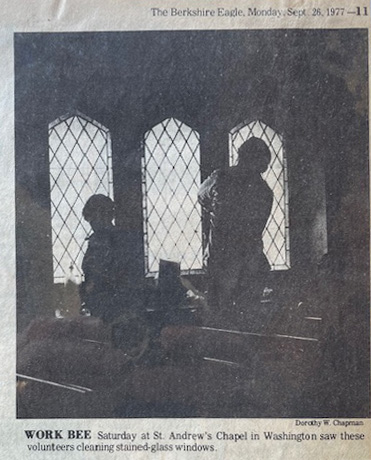
Fund Raisers were held, harvest dinners prepared, there was a Stone Chapel Concert Series and, in 2001, a group of residents organized The Washington Historic Tour and Quilt Exhibition. Proceeds from the tour helped restore the windows at St. Andrews Chapel—a job that was finally completed in 2023 by Guarducci Stained Glass Studios of Great Barrington.
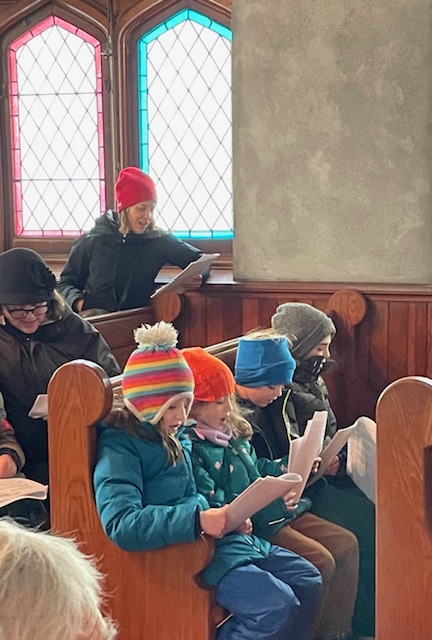
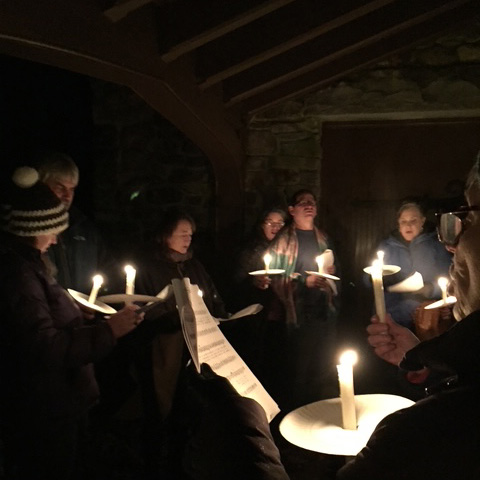
Funds continue to be raised from weddings and baptisms and special events like the Caroling evenings held for the past eleven years just before Christmas.
–––––––––––––––
To rent the church contact Rose Borgnis, Head of the Chapel Committee, ([email protected]) “I’ve always been passionate about St. Andrews,” Rose will tell you. She’s been watching over it since she was a teenager.
Many historical details for this article come from news clippings kept in an album by The Chapel Committee. Other details come from our Town History compiled for the 200th Anniversary of Washington, 1777-1977. Copies of the book can be purchased at the Town Hall on Summit Hill Road.